- about this author »
- all products by this author »
Review this product!
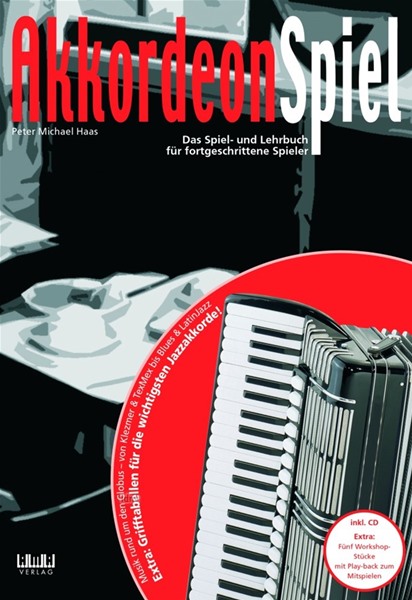
by Peter Michael Haas
The new way to learn how to play the accordion With simple pieces of Tango, Folklore, Jazz and Yiddish music
book , 180 pages + CD
Includes musette, jazz, Yiddish music, klezmer and folklore from all over the world. The method systematically proceeds from your first notes to you having full command of the complete standard bass and button fields on a 48 bass accordion. Mini improvisations and listening quizzes round out the concept.
Product No.: 610252E ISBN 978-3-89922-160-2 ISMN M-50155-112-5
incl. 7 % Tax excl.Shipping costs
When writing this book, I had two goals: first, to devise an interesting world music book and second, to construct a systematic accordion method book suitable to be used with or without a teacher, a method which would enable a step-by-step development towards a wholistic sense of musicianship. Many enthusiastic letters – and many sold books later – have let me know that this concept is successful. For the new edition I have changed one thing in particular: the fingerings for the left hand have been altered to conform with current pedagogical standards. Two practice pieces have also been added. Other than that, everything has been left as it was. The AMA publishers and I are always interested in feedback from readers. In fact, the number of letters posted to my website is quite astonishing … go have a look! But first and foremost: welcome to the club of accordionists – I wish you much fun and success! Peter M. Haas post@peter-m-haas.de http://www.peter-m-haas.de
Preface by Lydie Auvray Thanks Foreword CD-Index What size accordion is best for me? Chapter 1 Getting to know the accordion Fastening the instrument The bellow release button The bass tone C The bass tone C – short notes Notation for fingering The bass tone C and its neighbors The bass tones and their corresponding major chords Alternating between bass tones and chords How to hold the accordion The first accompaniments L’Aventure The very first waltz A circus march Finding orientation on the keys The registers Keys and pitch names – “white keys” The staff The notes in the treble clef The very first waltz The measure and the rhythmic values L’Aventure A circus march Legato and staccato Little legato exercise Melodies that everyone knows – 1 I’d like to have a little violin Someone fell into the well Hansel and Gretel Jingle Bells Dynamics Loud and soft A sentimental ballad floats over the courtyard Squirrel’s evening song Some gymnastics for the fingers Hearing quiz: intervals Right and left hand together L’Aventure – second version A sentimental ballade floats by again The very first waltz – second version A little barrel organ melody The very first waltz – third version Now the barrel organ gets going L’Aventure – third version Melodies that everyone knows – 2 I’d like to have a little violin Hansel and Gretel Jingle Bells Handling the bellows L’Aventure Chapter 2 New keys and new buttons New keys and notes for the right hand The D major chord The circus march in G major Things worth knowing about registers Squirrel’s evening song – second version New key position and new chord buttons A new position for the right hand The minor chords L’Aventure in D minor The left hand learns to spring Hearing quiz: D minor A new symbol: the quarter rest A waltz in D minor Montmartre Keys and pitch names – “black keys” Whole and half steps Sharps and naturals The flat Naming the notes Key signatures Seventh chords Exercises for the left hand La Petite New finger position Song for Theo Hearing quiz: C major and C minor New techniques for the right hand Changing positions A clown unpacks his suitcase The half rest When sailors sway to and fro New melody range for the right hand New bass buttons – the E row An afternoon on the Quai d’Orsay Things worth knowing about the insides of an accordion Going home in the evening Fingering: how to use the thumb The repeat symbol Autumn wind Changing positions – 2 The carousel An unusual position for the right hand “Guinness” – Melody from Ireland Listen: five notes in C major which you already know Fingering – crossing under and over Going up and down the scale The A minor scale Ballad for Micha – up and down in A minor Accidentals Key signatures 5 tones and a chord Eighth notes – more notes for each beat Tic Tac – for the right hand alone Tic Tac – with a simplified left hand Tic Tac – final version The buggy rolls through the countryside The carousel – second version, a little faster! The dotted quarter note or the 3/8 note Paris-Moscow Waltz: does it sound Russian or French? Melodies that everyone knows – 3 Jingle Bells Sur le pont d’Avignon Kalinka Accompanying with chord symbols A waltz for inspector Maigret Finger training for the right hand Grace notes: a little ornamentation Barrel organ piece Things worth knowing about the history of the accordion Position of the right hand Stout beer: Melody from Ireland New positions and bass buttons New positions and bass buttons – the B and E rows Fingering – silent change From A minor to F minor and back Transposing a melody A waltz for inspector Maigret – now in C minor Some words about improvising and chords Improv No. 1 Improv No. 2 Improv No. 3 A theme and an “accordion solo” Constructing triad chords on your own Chapter 3 Notes for the left hand The notes in the bass clef and their importance in playing the accordion A small reading exercise – the very first waltz The eighth rest Tango fever in A minor A little klezmer melody The alternate bass – more variety with a new bass technique Alternate bass fingering for major chords Circus march with alternate bass Miniature Csárdás Alternate bass fingering for seventh chords When sailors sway to and fro - with alternate bass Alternate bass fingering for minor chords Montmartre Exercise in fingering 4-note chords Things worth knowing about Yiddish songs and klezmer music Shalom Aleichem Bigger leaps for the left hand Night show ‘29 The 6/8 bar Playing two notes at once Amore mio … on the beach of the Grand Canal Exercise for the left hand A sentimental ballad floats over the courtyard Notation for dynamics New positions for the right hand Two melodies together in one staff Lydie Accompaniment for “Yolanda’s Peasant Dance” Hand positions for “Yolanda’s Peasant Dance” Yolanda’s Peasant Dance Changing positions in the right hand Musette waltz in C major D’accord! Things worth knowing about chanson and musette Melodies for the bass Chant Fingering exercises Day by day blues The counter basses Counter basses and major chords Someone fell into the well Stepping up and down the scale A ball in old Berlin Caribbean joke Rock the boogie!!! Triplets Tic Tac Three Mango Tango More about chords: 1. An extension of “D’accord!” 2. Accompanying with chords for “D’accord!” 3. Triads and their inversions 4. Getting to know the hand positions for the inversions The seventh chord in the right hand 5. New fingerings for “D’accord!” 6. Connecting chordal inversions Chapter 4 Getting to know the keys and key signatures The order of the keys G major and E minor Sol Majeur Musette 1001 Irish ballad D major and B minor Up and down the scale in D major New navigation symbols: “Segno” and “Coda” Viene la noche en Buenos Aires New button rows – B and F Mon amant de St. Jean C major and A minor … and again a big leap Hit the road, Joe! Things worth knowing about Argentinian tango The “Guinness” Jig Diminished chords Chords with foreign bass tones Choral for Johann Sebastian F major and D minor Dandy’s Swing Tumbalalayka The buggy rolls through the countryside B major and G minor A waltz for the B major scale Hava Nagila … and again a big leap Triads in the right hand Moscow nights E major and C minor Up and down the scale in E major The minstrel’s buggy rolls into the next village Sixteenth notes Footsteps from Bratzlaw Autumn Bird Greetings from Romania Musette 2001 Ways of notating accordion music Index
English Deutsch